As machine connectivity, production line management, and digital twin technologies continue to mature, the next challenge for smart manufacturing is enabling AI not only to understand data, but also to use existing systems and engineering tools to help complete real-world tasks.
Building on its capabilities in TLM production line management, CPS digital twins, and machine-level AI applications, Tongtai is further developing TLM Agent and CPS Agent. These technologies move AI beyond "answering questions" toward "assisting with task execution," exploring new possibilities as manufacturing advances from Automation toward Autonomous operations.

Technologies & Solutions
AI Agent for Smart Manufacturing
Enabling AI to Move from Understanding Manufacturing Data to Supporting Real-World Work

How Can AI Agents Take Smart Manufacturing to the Next Level?
From machine connectivity and manufacturing data visualization to digital twins and intelligent scheduling, the core of smart manufacturing has always been to enable equipment and data to be understood and utilized more efficiently. As these digital foundations continue to mature, manufacturers are beginning to face the next question: if AI can already understand data, can it also use existing systems and engineering tools to help engineers complete actual tasks?
This is why AI Agents are beginning to attract growing attention in manufacturing.
Compared with conventional generative AI, which focuses primarily on understanding questions, organizing information, and generating content, AI Agents place greater emphasis on task execution. Based on user requirements, an AI Agent can determine what information is needed, select the appropriate tools, and progressively connect workflows that were previously distributed across different systems. For manufacturing operations, this means AI may evolve from simply "answering questions" to "helping complete work."
Over the years, Tongtai has continuously advanced smart manufacturing technologies, from equipment connectivity and TLM production line management to CPS digital twins and machine-level AI applications. Building on these capabilities, Tongtai is further developing TLM Agent and CPS Agent. This article is based on the presentation "AI Agents for Smart Manufacturing" delivered by Bert Tseng, Associate Vice President of Tongtai's Smart Technology Division, at the 2026 Taiwan AI Academy Annual Conference. It explores how AI Agents can further connect existing smart manufacturing capabilities and reshape engineering workflows.
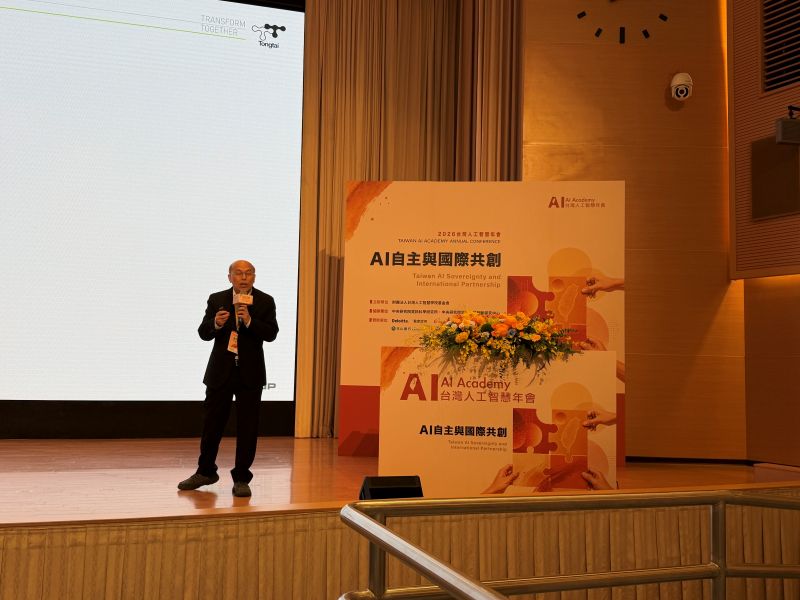
Figure: Bert Tseng, Associate Vice President of Tongtai's Smart Technology Division, presented "AI Agents for Smart Manufacturing" at the 2026 Taiwan AI Academy Annual Conference, outlining Tongtai's technology development from smart manufacturing, TLM, and CPS digital twins to AI Agents.
Smart Manufacturing Takes the Next Step as AI Moves from Analysis to Execution
Smart manufacturing did not begin with AI. Since the emergence of Industry 4.0, manufacturers have progressively established connections between physical equipment and the digital world. Tongtai defines the evolution of smart manufacturing through several stages: connectivity, visualization, transparency, prediction, intelligence, and ultimately self-optimization. This progression reflects a manufacturing system's increasing ability to understand shop-floor conditions - from acquiring machine data and monitoring real-time status, to identifying the causes of problems and predicting what may happen next.
These capabilities have already been applied in machine tool applications. Tongtai's current machine-level AI technologies include tool life prediction, spindle life prediction, thermal error compensation, feed-axis bearing predictive maintenance, tool surface defect inspection, and AI adaptive chip flushing. By combining machine data with AI models, these technologies help monitor machine health, machining conditions, and process quality.
These applications demonstrate that AI is gradually gaining the ability to "understand data" and "predict conditions." As these capabilities mature, a new requirement emerges: can AI go beyond providing analysis and begin using a company's existing systems and tools to help engineers perform their work? This is the key transition that Agentic AI brings to smart manufacturing.
From Generative AI to AI Agents: What Changes on the Shop Floor?
Generative AI has familiarized companies with using natural language to access information. In machine tool applications, for example, Tongtai developed the T-BOT machine-side CoPilot, which combines LLM and RAG technologies with relevant knowledge and real-time machine status to provide troubleshooting procedures and operating instructions. The goal is to reduce the learning curve for operators and improve troubleshooting efficiency.
The core of this type of application is enabling AI to better understand equipment, documents, and the questions being asked by users. AI Agents take this one step further by extending AI's role from information delivery to task execution.
Suppose an engineer wants to understand why the efficiency of a production line declined yesterday. Conventional generative AI can explain which items should be checked, such as equipment utilization, alarms, downtime records, and production history. An AI Agent, however, is designed to go further by retrieving the relevant data, consolidating historical records, using existing tools to perform analysis, and then presenting the results to the engineer for review.
The difference between generative AI and AI Agents, therefore, is not simply whether the answer is more comprehensive. The key difference is whether AI can understand a task and then use tools to help execute it. This distinction is particularly important in manufacturing, where engineers rarely work within a single system. Machine status, historical production data, CAM programs, machining simulation, and full-line capacity analysis often require engineers to move between multiple systems and engineering tools. The real value of AI Agents lies in their ability to connect these previously fragmented capabilities.
Why Manufacturing AI Agents Cannot Rely on LLMs Alone
Large Language Models (LLMs) provide language understanding, reasoning, and generation capabilities, but this does not mean they inherently understand how a factory operates. Just as a newly hired engineer with a strong technical background still needs to learn equipment specifications, data sources, workflows, system operation, and engineering decision criteria, AI also requires the corresponding enterprise knowledge and working environment.
In his presentation, Bert Tseng summarized this concept as:
Agent = LLM + Harness
Within Tongtai's AI Agent architecture, the Harness is not another AI model. Instead, it is a complete working environment that allows AI to acquire knowledge, follow defined working methods, and use external tools. It integrates capabilities such as VLM, MCP, Skill, RAG, Knowledge, AI Tools, Database, Python, and C#.
From a manufacturing perspective, Knowledge contains machine data, engineering standards, and enterprise knowledge. Skill structures the experience of how a task should be performed and how decisions should be made into methods that AI can understand. RAG helps AI retrieve information relevant to the current task from a large body of enterprise knowledge. MCP provides a mechanism for AI to interact with external systems such as TLM, databases, and simulation tools.
In other words, if an LLM addresses the question of whether "AI can understand and reason," the Harness addresses whether "AI has sufficient knowledge, methods, and tools to complete the work."
This is particularly important in manufacturing. A company's true differentiation does not necessarily come from which Large Language Model it chooses, but from whether years of accumulated equipment data, engineering expertise, workflows, and specialized tools can be organized into capabilities that AI can understand, access, and use.
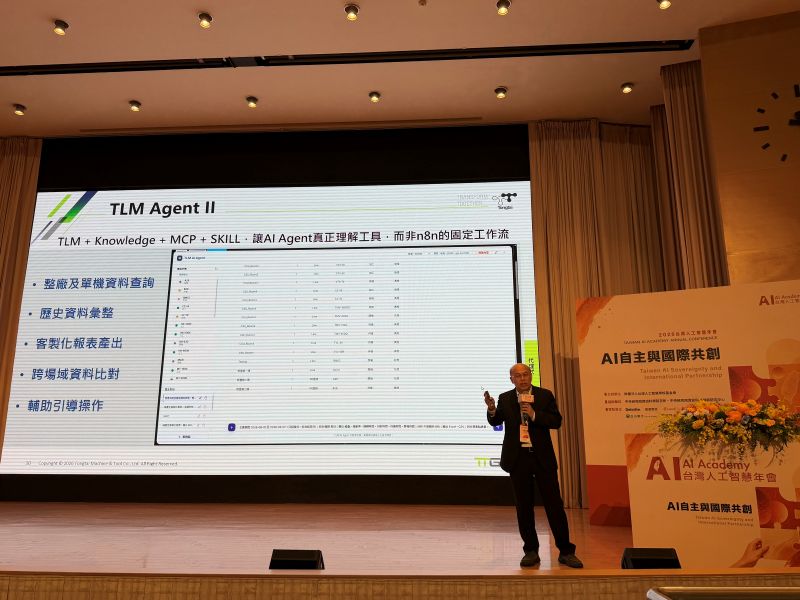
Figure: In Tongtai's AI Agent architecture, the LLM provides understanding and reasoning capabilities, while the Harness integrates Knowledge, Skill, RAG, MCP, and various tools, enabling AI to participate more directly in actual workflows.
TLM Agent: Moving Production Line Management from Function-Based Operation to Task Assignment
Tongtai's TLM (Tongtai Line Management System) is one of the key foundations of smart manufacturing. Through machine connectivity and production line data integration, TLM helps users monitor equipment, production, and historical data. Traditionally, engineers log in to the system, locate the required functions, retrieve data, and then organize and analyze the information.
When AI Agents are integrated with TLM, the way users interact with the system begins to change. Users no longer need to know in advance which page contains the required data. Instead, they can directly specify the task they want to accomplish, such as retrieving plant-wide or individual machine information, consolidating historical data, generating customized reports, or comparing production data across different sites.
TLM Agent II is designed to support plant-wide and individual machine data queries, historical data aggregation, customized report generation, cross-site data comparison, and guided operations. This change is not simply about adding an AI chat interface to existing software. It represents a fundamental rethinking of how industrial software is used.
In the past, a key software design challenge was helping users quickly find the functions they needed. In the Agent era, the challenge expands to enabling AI to understand system capabilities, understand the user's objective, and select the appropriate functions based on the task. This is also why Tongtai incorporates Knowledge, Skill, and MCP Server into its Native AI software design philosophy - so that industrial tools not only provide interfaces for human users, but also gradually become understandable and operable by AI Agents.
The Value of AI Agents Lies in Connecting Existing Manufacturing Tools
Actual manufacturing work often requires the simultaneous use of multiple systems. Therefore, the purpose of an AI Agent is not to "do everything by itself," but to determine what information is required for a task and which tools should be used.
Within the TLM Agent application architecture, different tools perform different functions. TLM provides historical production line data retrieval; FANUC NC GUIDE2 supports NC program simulation and cycle time calculation; and Tongtai's production line CPS provides capabilities such as production output forecasting, equipment utilization analysis, and Gantt chart visualization. Once these tools are integrated into a common workflow through an Agent, AI can begin assisting users with cross-system tasks.
Current TLM Agent demonstration applications include production line status queries, CAM program generation, individual machine machining simulation, and full-line capacity simulation. For engineers, this means that time previously spent searching for data, switching between systems, and performing repetitive operations can gradually be redirected toward work that requires greater engineering expertise, such as defining conditions, evaluating results, and improving solutions.
This is also an important distinction between AI Agents and fixed automated workflows. A fixed workflow generally follows predefined steps, whereas the development direction of AI Agents is to enable AI to understand the capabilities of different tools and select the appropriate operating method based on the task. For smart manufacturing, this means that system value is evolving from "providing functions" to "helping complete work."
CPS Agent: Enabling AI to Participate in Digital Twin Engineering Workflows
In addition to production line management, Digital Twin technology is another important application area for AI Agents in smart manufacturing. A digital twin creates a digital representation corresponding to actual equipment or production lines, allowing engineers to analyze processes, capacity, and layout before a line is physically built or modified.
However, the real barrier to digital twin implementation is not simply whether simulation software is available. Each production line has highly customized layouts and processes, and creating a model often requires both engineering analysis and programming capabilities. In practice, engineers who can program may not necessarily be familiar with engineering analysis, while engineers who are strong in engineering analysis may not have programming expertise. CPS Agent is designed to help bridge these previously separate engineering capabilities with AI.
Before a digital twin can be created, engineers must first understand the layout and automation process flow diagrams. Therefore, the first task of CPS Agent is "interpretation": progressively converting the way engineers read layouts, understand process flow diagrams, and prepare explanations into Skills that AI can use. Once the drawings have been interpreted, the Agent combines prompts, knowledge graphs, and relevant Skills to help convert equipment and process information into digital twin programs. This involves engineering knowledge related to equipment classification, process logic, and digital twin engine operation - not merely conventional code generation.
Once the digital twin program has been created, it must still be executed within the simulation engine so that simulation data can be collected and analyzed. The development focus of CPS Agent can therefore be understood as enabling AI to progressively participate in the complete engineering workflow of drawing interpretation, digital twin generation, simulation execution, and data analysis.
Importantly, this does not mean that engineering work is handed over entirely to AI. The complete CPS Agent workflow still retains human involvement in program review, modification, simulation result evaluation, and final confirmation. AI assists with the execution of substantial engineering work, while human professional judgment remains a critical part of the overall process.
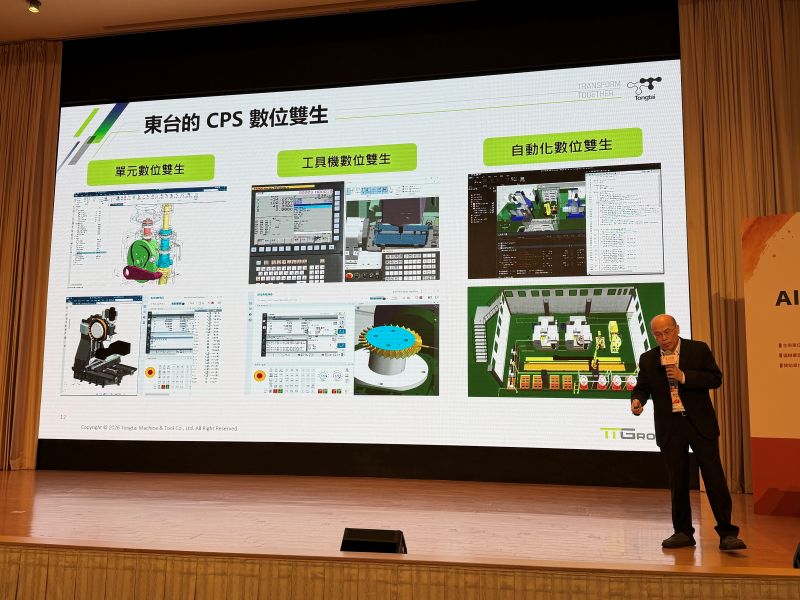
Figure: Tongtai provides digital twin engineering services ranging from individual cells and standalone machines to complete production lines.
AI Agents Not Only Improve Efficiency, but Also Help Structure Engineering Knowledge
Another important value of introducing AI Agents into manufacturing is the ability to reorganize and preserve engineering knowledge. Much of the most valuable manufacturing experience does not exist entirely in equipment manuals or SOPs. Instead, it is accumulated through the everyday judgment of experienced engineers. Examples include determining the most appropriate production line layout, identifying potential issues even when simulation data appears normal, or knowing which area should be checked first when a specific abnormal condition occurs. This type of experience is often tacit knowledge accumulated over many years.
Tongtai further maps the traditional capabilities of employees - "knowledge, skills, and tools" - to AI Agent architecture components such as knowledge graphs, Vector, Database, Skill, and MCP. This means that the process of implementing AI Agents also encourages companies to reorganize their engineering knowledge: which information should become Knowledge, which operating methods and decision rules can be structured as Skills, and which system capabilities should be converted into Tools that AI can use.
The long-term value, therefore, does not come simply from feeding large volumes of documents into AI. It comes from progressively digitizing the way engineers "make judgments" and "perform work," so that these capabilities can be preserved, reused, and ultimately used to support the training of new employees.
In terms of the human role, Tongtai divides human-Agent collaboration into three levels: Human, Human with AI Copilot, and Agent. This progresses from humans operating tools entirely by themselves, to humans defining parameters and making decisions while AI assists with repetitive tasks, and eventually to humans assigning tasks while AI Agents execute more complete workflows. This evolution is not about removing engineers from the manufacturing process. Instead, it gradually shifts their role away from extensive system operation toward problem definition, condition verification, result validation, and final decision-making.
From Three Working Days to a Few Hours: The Change Goes Beyond Execution Speed
Whether AI Agents can create real value for manufacturing ultimately has to be validated through actual engineering work.
According to Bert Tseng, CPS Agent has already been introduced into Tongtai's daily operations. One traditional manual workflow that previously required approximately three working days can now be completed in approximately 0.1 to 3 hours with AI Agent assistance. While the Agent is executing the task, engineers are also able to work on other assignments.
What makes this result significant is not simply a comparison of whether "humans or AI are faster." The more important change is that the workflow itself is being restructured. Many intermediate steps that previously had to be completed manually by engineers can gradually be delegated to the Agent, while engineers can devote more time to engineering judgment, solution modification, result validation, and final confirmation.
In other words, the benefit of AI Agents is not merely the automation of a specific operation. It is the opportunity to reconsider which work should remain the responsibility of people, which tasks can be assisted by AI, and how people and digital tools can collaborate more efficiently.
Figure: The value of AI Agents lies not only in faster execution, but also in shifting the focus of engineering work so that engineers can devote more time to evaluation, validation, and improvement.
From Automation to Autonomous: The Next Stage of Smart Manufacturing
Over the past decade, Industry 4.0 has continuously driven the integration of equipment, sensors, production line management systems, and digital twins, enabling manufacturing operations to become increasingly data-driven, visualized, analytical, and predictive. The emergence of AI Agents now raises the next question: once equipment, data, and tools have become increasingly digitalized, can AI actually understand and use these capabilities?
From this perspective, AI Agents are not intended to replace existing smart manufacturing systems. Instead, they are built on top of them. Without machine connectivity, there is no real-time data to retrieve. Without TLM, there is no comprehensive production line management information. Without CPS and Digital Twin technologies, there is no engineering simulation capability. Without the Knowledge and Skills accumulated by the enterprise over many years, AI cannot understand the context of actual engineering work.
The true significance of AI Agents for smart manufacturing, therefore, is not to add another AI software platform to the shop floor. It is to progressively transform a company's existing equipment, data, software, engineering knowledge, and working methods into manufacturing capabilities that AI can understand, connect, and use.
From equipment connectivity and TLM production line management to CPS digital twins and AI Agents, Tongtai's core objective has remained the same: to bring digital technologies into actual manufacturing workflows, helping engineers improve efficiency, accumulate knowledge, and create practical value on the shop floor.
As Industry 4.0 and AI continue to converge, smart manufacturing will advance from Automation toward a higher level of Autonomous operation. For manufacturers, the key issue in the next stage is not simply which AI model to choose, but whether the equipment, data, knowledge, and engineering capabilities accumulated over many years can be transformed into capabilities that AI can use to continuously create value in manufacturing.
Further Reading
AI Agent applications are built on smart manufacturing foundations such as equipment connectivity, data integration, production line management, and digital twins. For more information on the related technologies, see:
- Smart Manufacturing Overview: Understanding the complete transformation framework
- Sensor Technology Applications: Building the Data Foundation of Smart Manufacturing
- Machine Intelligence & Edge Computing: Making Every Machine Smarter
- Production Line Monitoring & Visualization: Creating Transparent and Efficient Manufacturing Operations
- Flexible Manufacturing Management & Intelligent Scheduling: Supporting High-Mix, Low-Volume Production
- Digital Twin & CPS Integration: From Virtual Validation to Real-World Manufacturing Deployment
FAQ
How does Tongtai apply AI Agents to smart manufacturing?
Tongtai's AI Agent applications are built on its existing smart manufacturing capabilities, including equipment connectivity, TLM production line management, CPS digital twins, and engineering data applications. Development currently focuses on TLM Agent and CPS Agent, enabling AI not only to understand manufacturing information, but also to assist with data retrieval, tool utilization, engineering simulation, and workflow execution.
How is TLM Agent different from the original TLM production line management system?
TLM originally focused on equipment and production line information integration, helping users monitor production status and historical data. With AI Agent capabilities added, the interaction model evolves from "operating system functions" toward "assigning tasks." TLM Agent can assist with plant-wide and individual machine data queries, historical data aggregation, customized reports, cross-site data comparison, and guided operations.
What digital twin tasks can Tongtai's CPS Agent assist with?
CPS Agent enables AI to participate in digital twin engineering workflows, including layout and process flow diagram interpretation, digital twin program generation, simulation execution, and data analysis. Its purpose is not simply to generate code using AI, but to connect engineering knowledge, working methods, and digital twin tools, helping bridge the gap between engineering analysis and software development.
Which manufacturing tools can Tongtai's TLM Agent connect with?
Within the TLM Agent application architecture, AI Agents can work with tools including TLM, FANUC NC GUIDE2, and Tongtai's production line CPS. These tools support tasks such as historical data retrieval, machining simulation, cycle time calculation, production output forecasting, and capacity analysis. By connecting these capabilities through an Agent, functions that were previously distributed across different systems can be integrated into a more complete task workflow.
Will Tongtai's AI Agents replace existing smart manufacturing systems?
No. AI Agents are built on top of existing smart manufacturing capabilities rather than replacing TLM, CPS, or other manufacturing tools. Equipment data, production line management, digital twins, engineering knowledge, and working methods are all essential foundations that enable AI Agents to participate meaningfully in manufacturing workflows. Tongtai's development direction is to enable AI to understand, connect, and use these existing capabilities, advancing smart manufacturing from Automation toward a higher level of Autonomous operation.